By early 2026, the "Cloud First" mantra of the previous decade has matured into something far more demanding: "Data-Driven Execution." For the modern CIO, simply having workloads in a hyperscaler environment is no longer a badge of success. The focus has shifted from the act of migration to the reality of optimization: cost, reliability, security, and speed of delivery.
Many organizations are currently suffering from what we call the "Migration Hangover": a state where cloud costs are ballooning, data remains siloed in legacy structures, and the promised agility of the cloud is stifled by technical debt. To break this cycle, a unified approach to platform modernization is required: cloud, data, and operating model moving together.
This guide expands into a practical pillar page for leaders who need modernization outcomes they can stand behind. It’s designed for teams looking for cloud modernization consulting that’s execution-first (not slide-first), and it’s anchored in a low-risk way to start: the Dark Consultancy Delivery Diagnostic, followed by an execution roadmap and hands-on delivery support.
You’ll also find tactical guidance on data platform modernization in regulated environments, plus how to prioritize competing initiatives using portfolio management consulting and PMO transformation so modernization doesn’t become a permanent program with no finish line.
The Convergence: Why Cloud and Data Are Inseparable in 2026
In the current "Agentic Era": where AI agents and autonomous workflows are becoming standard: the infrastructure and the data it carries can no longer be managed as separate entities. Cloud modernization consulting has evolved to address this convergence, because every business capability now rides on the platform: data products, APIs, integration, identity, and governance.
If your cloud infrastructure is modern but your data platform is legacy, your AI initiatives will fail due to latency, poor data quality, and slow access approvals. Conversely, a modern data stack sitting on unoptimized, legacy cloud architecture will result in astronomical egress costs, noisy-neighbor performance bottlenecks, and availability issues that show up as “AI doesn’t work.”
Real ROI is found at the intersection of these two disciplines: a platform that is cost-aware, secure-by-default, and designed to ship changes predictably.
What “good” looks like in 2026:
- A shared execution roadmap: cloud and data modernization plan from the same baseline, sequenced together, funded together.
- A modern delivery system: delivery governance that reduces surprise and accelerates decisions, not a weekly status theater.
- A platform product mindset: platform teams serving internal product teams with clear service levels and golden paths.
- Governance without gridlock: policy-as-code, data access patterns, and compliance controls that don’t require heroics.

Phase 1: The Low-Risk Entry – The Delivery Diagnostic (Execution-First, Not Slide-First)
Most modernization failures start with a lack of visibility and a shaky operating model. Organizations often commit to multi-year, multi-million dollar "Big Bang" transformations without understanding their baseline, how delivery will actually work, or where risk is hiding. At Dark Consultancy, we advocate for a low-risk engagement model centered on a Delivery Diagnostic: a short, structured assessment that answers “what’s real?” before the organization spends its political capital.
This is the core of our execution-first mindset: if we can’t measure it, we don’t pretend we can manage it.
What the Delivery Diagnostic Actually Produces
A good diagnostic is not a “current state deck.” It’s a decision tool. It should produce:
- A prioritized set of modernization candidates (apps, data domains, platforms) with clear disposition recommendations
- A delivery risk profile (where delivery predictability breaks, why, and how to fix it)
- A baseline for cost, reliability, and cycle time (so ROI is measurable)
- The first version of an execution roadmap: sequence, dependencies, milestones, and governance checkpoints
Automated Discovery and Assessment
Before touching a single line of code, you must conduct an automated discovery of your ecosystem. In 2026, this isn't just about inventory; it’s about identifying the "Expensive 20%." Typically, 20% of your workloads drive 80% of your cloud spend, incident volume, or technical friction.
The Diagnostic focuses on:
- Workload Health: Identifying "zombie" servers, underutilized instances, and brittle legacy runtimes.
- Data Gravity: Understanding where your most valuable data sits, how it moves, and what compliance boundaries it crosses.
- Execution Gaps: Benchmarking delivery speed, release predictability, and decision latency (how long approvals and escalations actually take).
- Delivery Governance Reality Check: What governance exists on paper vs. what happens in delivery: tooling, stage gates, exception processes, and ownership.
By starting with a diagnostic, leadership can secure "Quick Wins": retiring redundant systems, right-sizing resources, and removing obvious blockers. These often yield 15-25% immediate cost savings, effectively self-funding the next phases while building credibility that the roadmap is executable.
Phase 2: Strategic Migration and Replatforming (The 6Rs) + Delivery Governance That Actually Works
Once the diagnostic is complete, the execution phase begins. We utilize the 6Rs framework: Retire, Retain, Rehost, Replatform, Refactor, and Replace: to ensure every application has a clear destination.
But here’s the part that gets missed: modernization is not just a technical plan. It’s a delivery system. The difference between “we migrated stuff” and “we can deliver reliably in cloud” is delivery governance: how priorities are set, how teams get unblocked, how risk is controlled, and how decisions are made quickly (with the right people in the room).
From "Lift and Shift" to Cloud-Native
The era of simple rehosting (Lift and Shift) is largely over for competitive enterprises. In 2026, 95% of new digital workloads are built using cloud-native architectures. To achieve a 50% increase in development speed, organizations are increasingly moving toward:
- Containerization: Moving applications to Kubernetes or managed container services to ensure portability.
- Serverless Integration: Leveraging event-driven architectures to reduce idle resource costs.
- Infrastructure as Code (IaC): Using tools like Terraform to ensure environments are reproducible and secure by design.
Delivery Governance: Practical Controls Without Slowing Teams Down
Modern delivery governance should be lightweight, measurable, and focused on removing risk early. The tactics we see work in enterprise and public-sector environments:
- Weekly delivery scorecard (not a status report): release predictability, lead time, escaped defects, cloud cost deltas, top blockers, and decision requests.
- Clear ownership boundaries: who owns platform guardrails, who owns product outcomes, who owns shared services.
- Decision SLAs: architecture/security decisions within days, not weeks. If an exception is needed, define who can approve it and what evidence is required.
- Quality gates that are automated: policy-as-code, IaC scanning, container scanning, and data access controls integrated into CI/CD.
This phase isn't just about moving files; it's about changing how software is delivered. For a deeper look at aligning this technical shift with your business goals, see our guide on The Execution Roadmap.

Phase 3: Data Platform Modernization for the AI Era (Including Regulated Environments)
A cloud migration without a corresponding data platform modernization strategy is half-finished work. To derive real value from 2026’s AI capabilities, your data must be accessible, structured, and "agent-ready": discoverable, governed, and usable through secure interfaces.
The Modern Data Stack
Modernization involves transitioning from rigid, on-premise data warehouses to flexible, cloud-based data lakes and lakehouses. Key priorities include:
- Vector Databases: Essential for supporting Large Language Models (LLMs) and semantic search.
- Event-Driven Pipelines: Moving away from batch processing to real-time data streaming (e.g., Kafka or cloud-native alternatives).
- Data Governance: Automating compliance and security at the data layer, ensuring that "garbage in" doesn't become "garbage out" for your autonomous systems.
The goal is to consolidate and secure data so that it can be leveraged for modern analytics, operational intelligence, and AI-assisted workflows without creating a compliance incident.
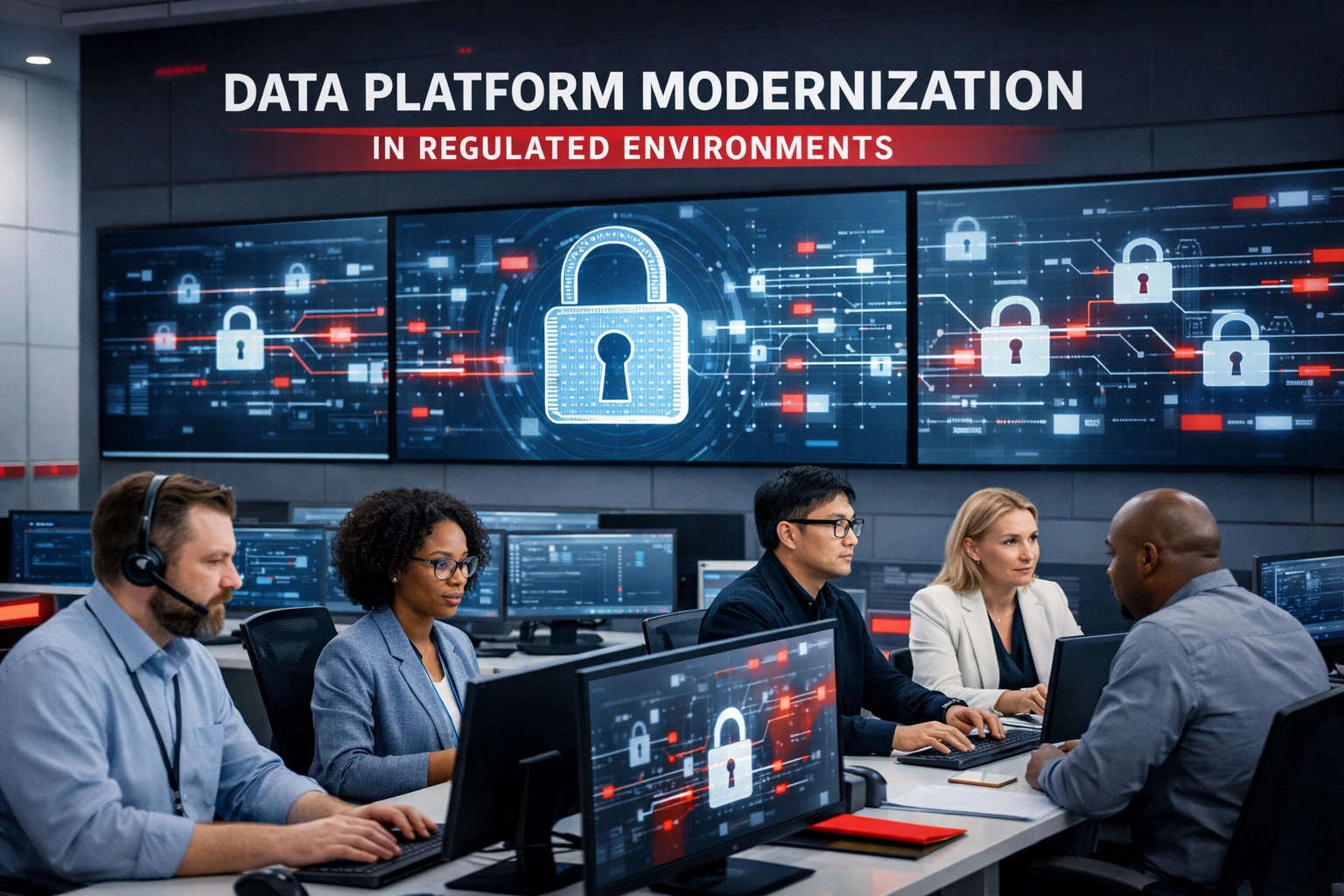
Data Platform Modernization in Regulated Environments (Public Sector + Finance)
In regulated environments, teams often assume governance means “slow.” It doesn’t have to. The trick is to design compliance into the platform so teams can ship faster because guardrails are standardized.
Here are the tactical patterns that consistently reduce risk while improving delivery speed:
1) Classify data early, then automate enforcement
- Define data classes (e.g., public, internal, confidential, restricted) and map them to controls: encryption, retention, access approvals, logging.
- Implement tagging standards at ingestion so classification travels with the data (datasets, columns, files, topics).
- Enforce controls with policy-as-code where possible so teams don’t reinvent controls per project.
2) Build “secure-by-default” landing zones for data
For data platform modernization in finance/public sector, a secure landing zone should include:
- Separate accounts/projects/subscriptions for environments (dev/test/prod) with tight boundary controls
- Centralized key management and encryption defaults (at rest and in transit)
- Network segmentation, private endpoints, and controlled egress
- Baseline audit logging turned on by default, routed to a security operations pattern
3) Use access patterns that satisfy auditors and unblock teams
A common failure mode is ad hoc access. Better patterns:
- Role-based access with least privilege and time-bound elevation for production access
- “Data product” interfaces: APIs, governed views, and semantic layers instead of direct table access
- Approval workflows integrated into identity tooling so access is traceable, reviewable, and revocable
4) Make lineage and evidence a first-class product
Auditors want evidence. Delivery teams want not to manually create it.
- Capture lineage automatically (pipeline → dataset → report/model) so impact analysis is fast
- Maintain a control-to-evidence map: “this control is satisfied by these logs/configs/tests”
- Keep immutable logs for sensitive access and changes (who/what/when)
5) Plan for residency, retention, and exit—up front
Public sector and finance programs get stuck late when these are treated as “future problems.”
- Define data residency constraints per domain (and what “allowed regions” means)
- Implement retention and legal holds as platform capabilities
- Build an exit plan: portability, backups, and how data moves if strategy changes
6) Don’t let AI bypass governance
If you’re enabling LLMs:
- Ensure sensitive data never lands in unapproved prompts or external tools
- Use retrieval patterns that respect entitlements (RAG with access control)
- Establish model risk management checkpoints (bias, explainability, auditability) aligned to your regulator expectations
When Modernization Becomes a Rescue Mission (And What to Do About It)
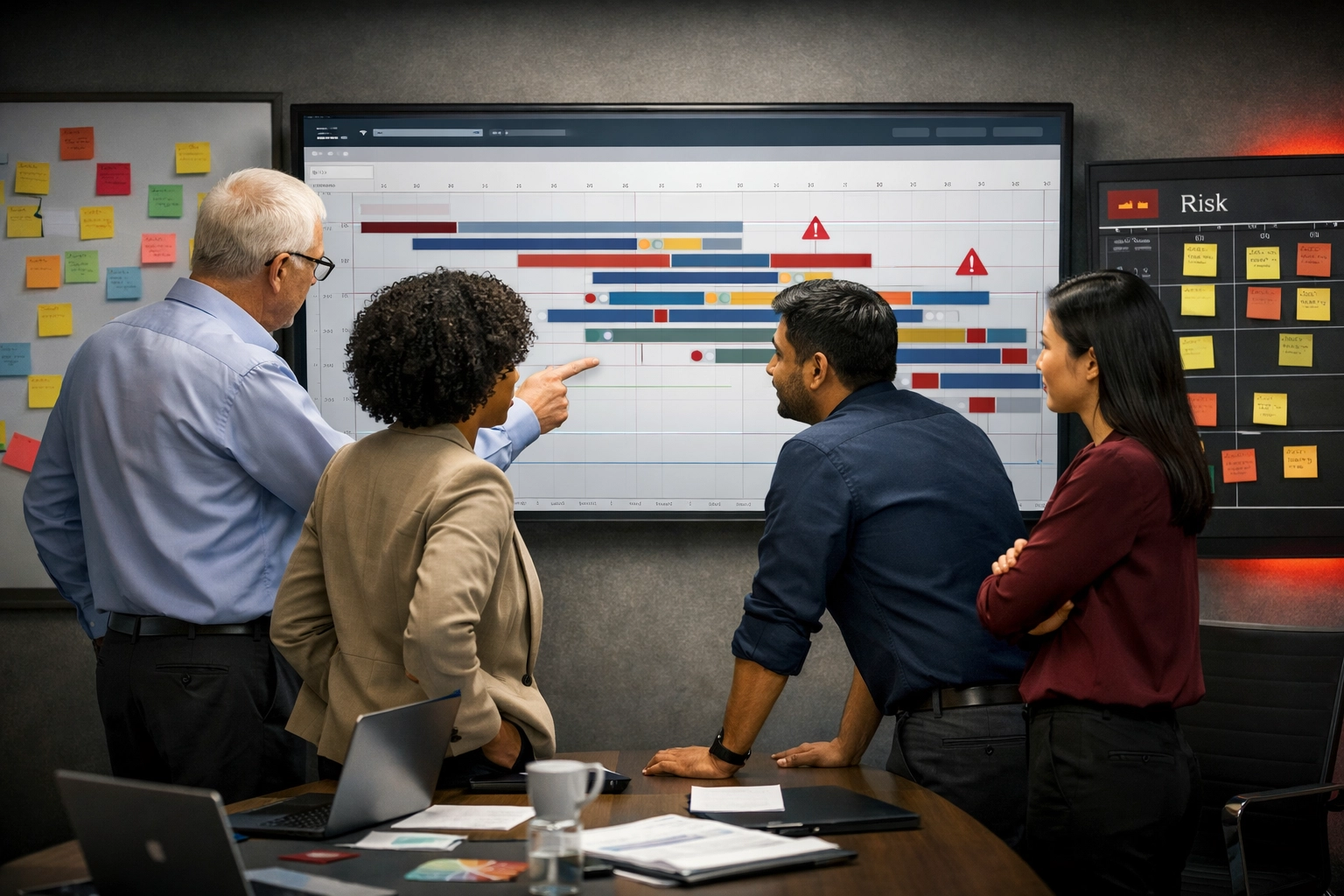
Modernization programs rarely “fail” in one dramatic moment. They drift: missed milestones, constant replans, vendor dependencies that never resolve, and a backlog that grows faster than teams can deliver. Eventually the business loses trust, funding gets threatened, and modernization becomes a rescue effort.
Signals you’ve crossed the line into rescue territory:
- Your roadmap is mostly dates, not dependencies (and every dependency is “in progress”).
- Teams are busy, but releases are infrequent and risky.
- Architecture decisions take weeks, while delivery issues show up daily.
- Security/compliance reviews happen late, forcing rework and exceptions.
- Cloud costs rise without a measurable improvement in reliability or cycle time.
What an execution-first rescue approach looks like:
- Re-baseline the truth with a Delivery Diagnostic (scope, risk, delivery capacity, and where governance is breaking).
- Stop the bleeding: freeze low-value scope, stabilize environments, and focus on a thin slice to production.
- Rebuild the execution roadmap around outcomes (service reliability, cost, time-to-release) and enforce a realistic sequence.
- Tighten delivery governance so decisions happen fast and blockers have owners.
If you’re already in the danger zone, go deeper here: The Ultimate Guide to Program Rescue Consulting.
Measuring Success: The ROI Framework
Modernization is an investment, not an expense. To maintain executive buy-in, you must track the right metrics. Based on our 2026 benchmarks, organizations following this roadmap should target the following improvements over an 18-month period:
| Metric | Baseline (Legacy) | Target (Modernized) |
|---|---|---|
| Spend Efficiency | 50% Waste (Idle/Unoptimized) | 85%+ Optimal Utilization |
| Release Frequency | Monthly/Quarterly | Daily or On-Demand |
| Mean Time to Recovery (MTTR) | Days/Hours | Minutes (Automated) |
| Data Accessibility | Siloed / Batch-heavy | Real-time / API-first |
Implementing FinOps practices is a critical component of this ROI. By identifying idle resources and reclaiming 25-35% of cloud spend, businesses can redirect those funds into innovation projects rather than just "keeping the lights on."

Portfolio Management Consulting: Prioritizing Modernization So It Actually Lands
Modernization demand always exceeds capacity. Without strong prioritization, you end up with a long list of “top priorities,” teams thrashing across initiatives, and leadership relying on hope instead of tradeoffs. This is where portfolio management consulting becomes the difference between a strategy and an executable plan.
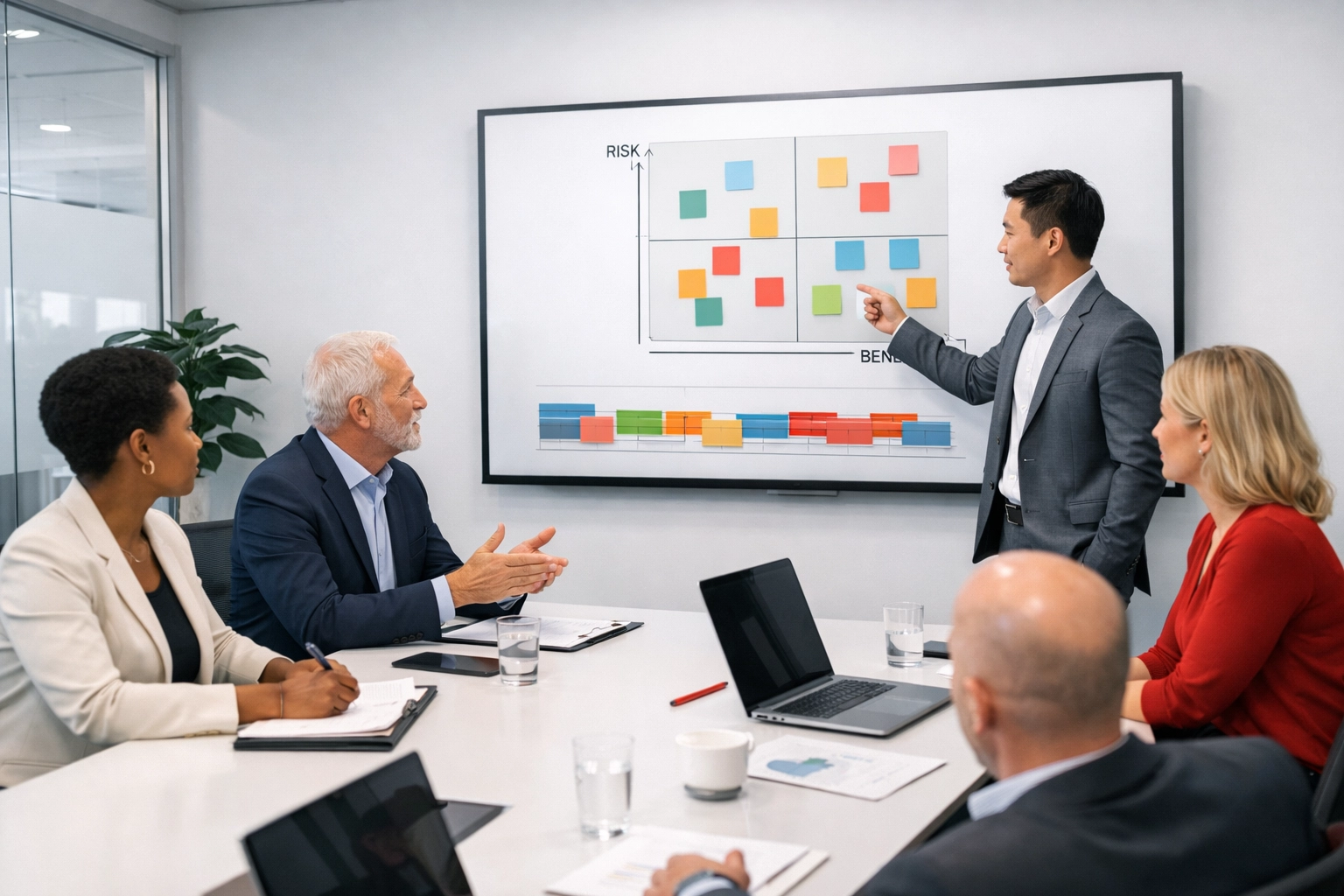
A practical portfolio approach (that works in regulated enterprises too):
1) Create a single modernization portfolio view
Combine cloud modernization, data platform modernization, security uplift, and platform engineering work into one portfolio view with consistent scoring. This prevents “shadow modernization” where each group runs its own roadmap and nobody sees the collisions.
2) Prioritize by outcome + constraint, not enthusiasm
Use a simple scoring model that leadership can defend:
- Business outcome: revenue enablement, customer impact, operational risk reduction
- Regulatory / operational risk: findings, EOL exposure, incident history, audit deadlines
- Dependency weight: foundational items that unblock multiple programs (identity, networking, data access patterns)
- Delivery readiness: is there a team, a sponsor, and an environment that can ship within weeks?
3) Sequence initiatives into an execution roadmap
This is where an execution roadmap becomes real: it captures dependencies, staffing constraints, and governance checkpoints. The roadmap should make it obvious what is not happening this quarter, and why.
4) Put delivery governance around the portfolio, not just projects
Strong delivery governance at the portfolio level includes:
- Monthly portfolio steering focused on decisions and tradeoffs (not reporting)
- A cross-cutting risk register (security, compliance, vendor, environment readiness)
- Standard entry/exit criteria for initiatives (so you stop funding work that can’t ship)
5) Align the PMO to execution (PMO transformation)
If your PMO is tracking tasks but not improving outcomes, it’s time for PMO transformation:
- Shift from activity reporting to outcome metrics (predictability, cycle time, risk burn-down)
- Standardize milestone definitions across teams (so status means the same thing)
- Build escalation paths with decision-makers who can actually unblock work
Foundational Modernization Pillars
Platform Engineering: The Developer Experience
In 2026, the leading edge of platform modernization is the rise of Platform Engineering. This shift involves creating Internal Developer Platforms (IDPs) that provide developers with self-service capabilities.
Instead of developers waiting weeks for a database or a test environment, the IDP provides a "Golden Path" with security guardrails and compliance baked in. This reduces cognitive load on engineering teams, allowing them to focus on product features rather than infrastructure plumbing. This is the ultimate "ROI multiplier" because it accelerates the entire software development lifecycle (SDLC).
Addressing Technical Debt: The Java 25 Pivot and Beyond
Modernization also requires keeping pace with the underlying stacks. A major priority in 2026 is the transition to modern runtimes, such as Java 25, to deprecate legacy Java 11 environments. This single shift can reduce vulnerability exposure by an average of 60% while providing significant performance gains in cloud-native environments.
Ignoring these "end-of-life" technology signals creates security risks that can wipe out any ROI gained from cloud migration. A proactive modernization roadmap includes regular "tech stack refreshes" as a standard operating procedure.
Conclusion: Start with Execution in Mind
The difference between a successful transformation and a failed one often comes down to the quality of the initial roadmap and the operating model behind it. For CIOs and CTOs, the message for 2026 is clear: stop planning in a vacuum and start executing with data, tight feedback loops, and delivery governance that drives decisions.
Bridging cloud and data platforms is no longer optional: it is the prerequisite for participating in the AI-driven economy. By starting with a Delivery Diagnostic, you mitigate risk, identify immediate savings, and build the momentum necessary for deep-rooted modernization. From there, a clear execution roadmap keeps sequencing realistic, makes tradeoffs explicit, and ensures delivery stays measurable.
If you want to pressure-test your modernization plan (or rescue one that’s drifting), let’s keep it simple: book a quick conversation and we’ll tell you what we’d validate first—and what we’d stop doing immediately. Contact us to discuss a Delivery Diagnostic, or explore our broader range of services to see how we help enterprises deliver outcomes, not presentations.