Every CIO knows the script by heart: the vendor promises seamless integration, agile velocity, and digital transformation. Six months later, you're managing three separate teams who won't talk to each other, a backlog growing faster than your delivery pipeline, and a platform that buckles under peak load.
Traditional IT outsourcing isn't just failing, it's structurally incapable of delivering mission-critical platforms at scale. The model treats engineering as a cost center, fragments accountability across vendors, and optimizes for billable hours rather than outcomes.
Product engineering services represent a fundamentally different operating model. Not consulting theater. Not staff augmentation with a fresh label. A unified approach where design, engineering, infrastructure, and operations function as a single accountable unit, with one north star: shipping reliable systems that perform under pressure.
The Coordination Tax Nobody Talks About
The dirty secret of platform modernization failures isn't technical debt or legacy systems. It's coordination complexity, the exponential drag that occurs when architecture decisions require twelve Zoom calls across four time zones.
In traditional engagements, mobile teams wait on backend APIs. Backend engineers wait on infrastructure provisioning. DevOps waits on security sign-offs. Everyone waits on "the architecture review board" that meets twice a month. Each handoff introduces lag, translation errors, and diffused accountability.

Product engineering services eliminate these seams. When the team designing the user experience sits three feet from the engineers building the microservices, and both report to the same delivery leader accountable for uptime, coordination stops being a tax and becomes a competitive advantage.
Organizations that unify these functions see products reach production 40% faster with materially fewer defects escaping to production environments. Not because people work harder. Because they stop working against fragmented incentives.
The 2026 Context: Building for the Agentic Era
Here's what changed between 2024 and today: your platform isn't just serving human users anymore. AI agents are now first-class consumers of your APIs, evaluating vendors, comparing features, and making purchase recommendations without human intervention.
If your product data isn't structured for programmatic access, if your documentation requires human interpretation, you're invisible to the fastest-growing traffic source on the internet. Agentic systems prioritize platforms with clean API contracts, comprehensive schemas, and machine-readable service descriptions.
This isn't future-gazing. By February 2026, enterprises across financial services, healthcare, and public sector operations are already adapting architectures specifically for agent interoperability. Product engineering services that ignore this reality are building for yesterday's users.
Platform modernization in 2026 means designing systems that serve both constituencies simultaneously: responsive UX for human operators and deterministic, well-documented interfaces for autonomous agents making decisions in milliseconds.

Delivery Governance: The Execution Multiplier
The phrase "delivery governance" sounds like compliance overhead, another artifact of waterfall thinking. In practice, it's the primary mechanism that separates high-performing product engineering teams from glorified body shops.
Delivery governance means establishing clear ownership, measurable outcomes, and forcing functions that surface risk before it metastasizes. It's the difference between "we're 80% done" (forever) and "we shipped to production Thursday at 4 PM, here's the observability dashboard."
Dark Consultancy's execution-first model operationalizes this through three non-negotiable pillars:
Unified Delivery Ownership: One accountable leader owns the entire stack, from user research through production deployment. No "that's not my team" escape hatches.
Instrumentation From Day One: Observability isn't a phase-three add-on. Every service ships with structured logging, distributed tracing, and SLO dashboards that report actual user experience, not vanity metrics.
Continuous Risk Surfacing: Weekly delivery reviews focus on leading indicators, deployment frequency, change failure rate, mean time to recovery. Not PowerPoint status reports with green checkmarks.
This framework transforms product engineering services from a vendor relationship into a capability extension of your organization. Teams operate with the urgency and accountability of internal product owners because the incentive structure rewards outcomes, not activity.
The Platform-as-Product Shift
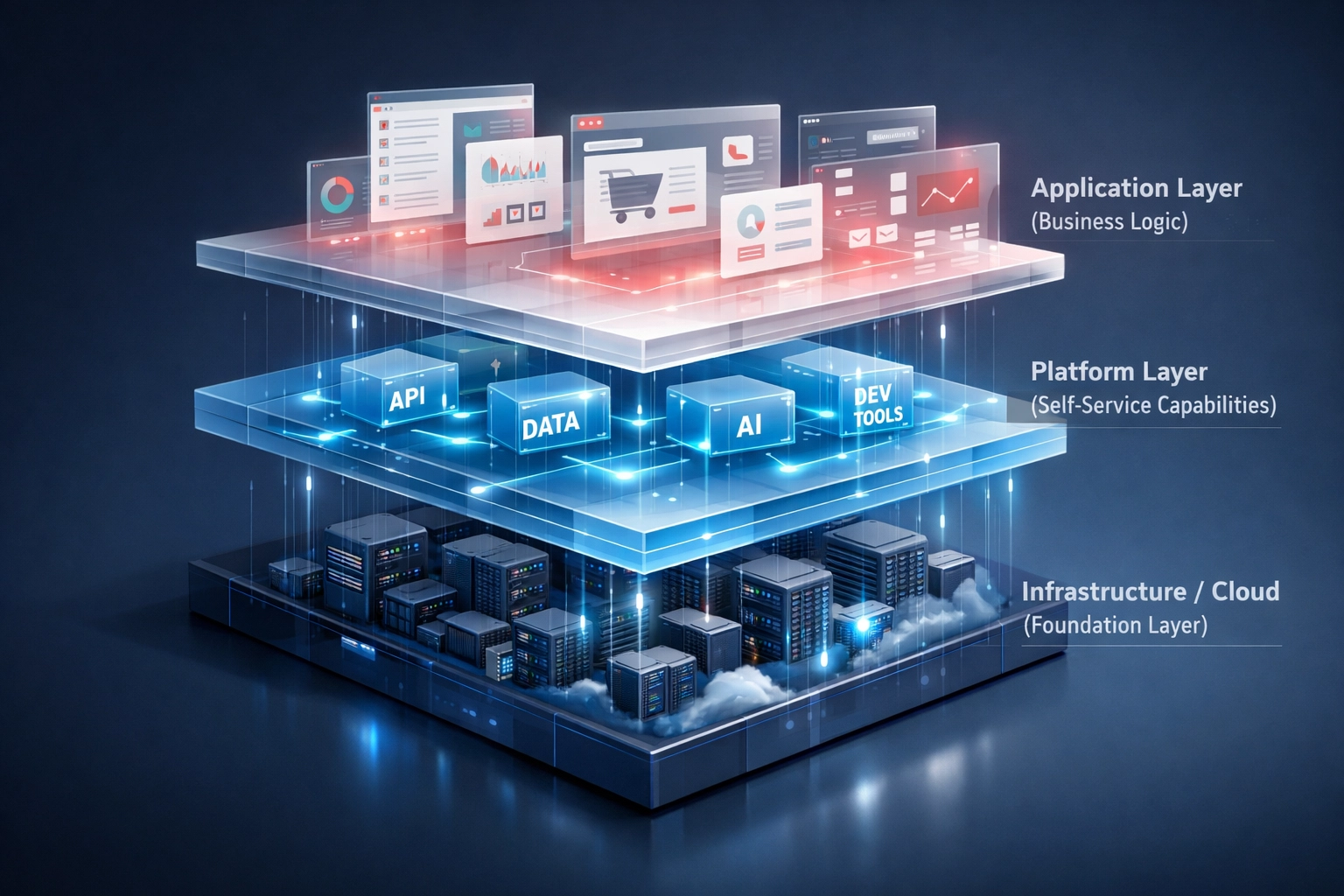
Mission-critical systems can't scale by replicating complexity across teams. The platform engineering movement recognizes this: instead of every team independently assembling infrastructure, CI/CD pipelines, and observability stacks, platform teams productize these capabilities with self-service interfaces.

This isn't centralized control masquerading as DevOps. It's intentional capability design where platform teams become accountable for adoption and reliability, measured by how effectively application teams ship without intervention.
When done correctly, this redistributes cognitive load. Application engineers focus on business logic. Platform teams own the "paved road" that makes secure, compliant, scalable deployment the path of least resistance. The result: organizations scale delivery capacity without scaling coordination overhead.
Product engineering services that embed platform thinking from project inception avoid the technical debt spiral that kills modernization initiatives eighteen months in. They build systems designed for extension, not just initial launch.
AI-Powered Execution in Practice
The integration of AI capabilities into product engineering workflows isn't about replacing engineers, it's about eliminating the repetitive cognitive load that prevents senior talent from focusing on architectural decisions that matter.
Modern product engineering services leverage AI across the delivery lifecycle:
Automated Testing at Scale: AI-powered regression suites catch breaking changes across microservices before they reach staging, reducing the time between commit and confidence from days to minutes.
Predictive Resource Planning: Machine learning models forecast infrastructure needs based on usage patterns, automatically provisioning capacity before traffic spikes hit, critical for platforms where downtime costs millions per hour.
Code Quality Acceleration: Static analysis enhanced by AI flags security vulnerabilities, performance anti-patterns, and maintainability issues during pull request review, preventing technical debt from accumulating silently.
These aren't theoretical capabilities. They're operational requirements for product engineering teams shipping mission-critical platforms in 2026. The performance gap between organizations using these tools and those relying on manual processes now measures in months of delivery velocity.
What Execution Actually Looks Like
Real product engineering services deliver against observable milestones:
A financial services platform handling 50 million transactions daily ships new features weekly while maintaining 99.99% availability. Not through heroics: through boring excellence in deployment automation, feature flagging, and progressive rollouts.
A public sector modernization initiative migrates core services from mainframe to cloud-native architecture without user-facing disruption. Not by working weekends: by treating migration as a product with clear acceptance criteria and ruthless scope control.
An enterprise SaaS platform scales from 10,000 to 500,000 concurrent users without architectural rewrites. Not through over-provisioning: by building cloud-native from inception with autoscaling, circuit breakers, and multi-region failover baked into every service.
These outcomes share a common pattern: execution-first thinking where delivery velocity, system reliability, and operational excellence aren't competing priorities: they're mutually reinforcing capabilities built into how teams operate.
The Path Forward
Platform modernization in 2026 demands more than technical competence. It requires organizational models that align incentives around outcomes, governance structures that accelerate rather than impede delivery, and architectural patterns that serve both human users and autonomous agents.
Traditional IT outsourcing optimizes for the wrong variables. Product engineering services: when implemented with rigorous delivery governance and platform thinking: provide the execution framework that mission-critical systems require.
The question facing technology leaders isn't whether to modernize. It's whether to modernize with a model built for accountability and scale, or continue optimizing a vendor relationship designed for a world that no longer exists.
Dark Consultancy specializes in execution-first product engineering for organizations where platform reliability directly impacts business outcomes. If your modernization initiative requires more than vendor promises: if you need accountable delivery with measurable results( let's talk.)